

Selecting the right career path is crucial for professional success and long-term satisfaction. For life science graduates, career options after completing a degree in pharmacy, biotechnology, or biochemistry often come down to two promising fields — Quality Assurance (QA) and Regulatory Affairs (RA).
What is QA? Roles & Responsibilities
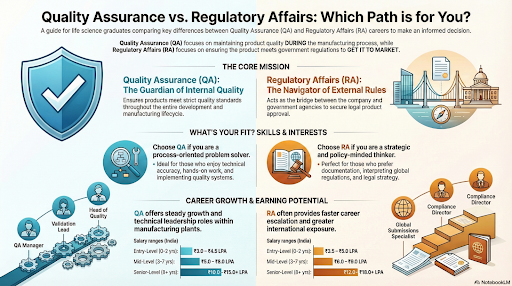
Quality Assurance (QA) focuses on maintaining product quality throughout the manufacturing process, while Regulatory Affairs (RA) focuses on ensuring the product meets government regulations to get it to market.
Key Responsibilities of QA Professionals
- Developing and Monitoring Operating Procedures (SOPs): To ensure quality and consistency.
- Conducting Audits: Of production processes to verify compliance.
- Ensuring Documentation Quality: Maintaining proper records.
- Checking Raw Materials: Approving materials before they enter the manufacturing.
- Handling product deviations, OOS & OOT: Troubleshooting quality issues.
Summary: QA is for professionals who are process-oriented and detail-oriented.
What is RA? Roles & Responsibilities
Regulatory Affairs (RA) acts as the bridge between the company and government agencies. They ensure products comply with all applicable regulations before they are launched in the market.
Key Responsibilities of RA Professionals
- Preparation of Dossiers: Compiling scientific data for product approval.
- Legal Compliance: Ensuring legal requirements are met.
- Communicating with Health Authorities: Liaising with FDA, EMA, CDSCO, etc.
- Supporting Post-Marketing activities: Handling lifecycle management.
- Keeping up with Regulations: Monitoring changes in global regulations.
Summary: RA acts as a bridge between the company and regulatory bodies, ensuring compliance.
Get Professional Guidance — Contact Our Team
Connect NowQA vs RA: Key Differences
Although both fields ensure safe and effective products, their focus and scope is different.
| Facet | Quality Assurance (QA) | Regulatory Affairs (RA) |
|---|---|---|
| Main Focus | Monitoring internal processes and systems. | Ensuring compliance with government regulations. |
| Primary Responsibility | Implements quality systems on plant. | Navigating pathways to approval of licensing. |
| Work Environment | Manufacturing Units, QC Labs, Production floors. | Corporate offices, document-centric roles, and policy management. |
| Interactions | Internal teams (production, QC). | Health Authorities, R&D, legal teams. |
| Core Outcome | Consistent Product Quality and Compliance. | Product Approval and Market Entry Authorization. |
Which Career is Better and Why?
Choosing between QA and RA depends on your interests and career goals.
- Choose QA if: You enjoy hands-on work, process validation, and ensuring product quality systems.
- Choose RA if: You prefer strategy, documentation, global regulations, and legal aspects of the pharmaceutical industry.
| Field Comparison | Recommendation Based on |
|---|---|
| Work-Life Balance | RA typically offers better balance. |
| Salary & Growth | RA often offers faster growth. |
Skills Required for QA and RA
Identifying your core skills can help you choose the right path.
Essential Skills for QA Professionals
- Knowledge of GMP (Good Manufacturing Practices) guidelines.
- Attention to Detail & Analytical Thinking.
- Risk Assessment & Problem Solving capabilities.
- Sample handling & Documentation.
Essential Skills for RA Professionals
- Excellent Writing & Communication skills (for Dossiers).
- Understanding of Global Regulations.
- Strategic Thinking & Negotiation skills.
- Coordination & Collaboration with multiple departments.
Career Growth & Salary Comparison
Both fields offer distinct growth trajectories. Here as an estimation of entry-level salaries in India:
| Level | QA - Average Annual Salary (INR) | RA - Average Annual Salary (INR) |
|---|---|---|
| Entry Level (0-2 yrs) | ? 2.0 - ? 3.5 LPA | ? 2.5 - ? 4.0 LPA |
| Mid Level (3-5 yrs) | ? 4.0 - ? 6.5 LPA | ? 5.0 - ? 8.0 LPA |
| Senior Level (8+ yrs) | ? 10.0 - ? 15.0+ LPA | ? 12.0 - ? 20.0+ LPA |
| Growth Opportunities | Stable and steady growth. | Faster salary growth. |
Conclusion
In the ever-expanding pharmaceutical and biotech industry, Quality Assurance (QA) and Regulatory Affairs (RA) are vital, and both offer promising, recession-proof careers.
If you prefer monitoring processes and ensuring quality standards, go for QA. If you prefer strategy, documentation, and compliance, choose RA. Both are excellent choices for life science graduates.
For more insights and to explore online upskilling in these domains, consider checking out our Advanced Diploma in Drug Regulatory Affairs program.
Final Thoughts: Both QA and RA are indispensable pillars of the approved supply chain and critical to safe pharmaceutical products in the market.